

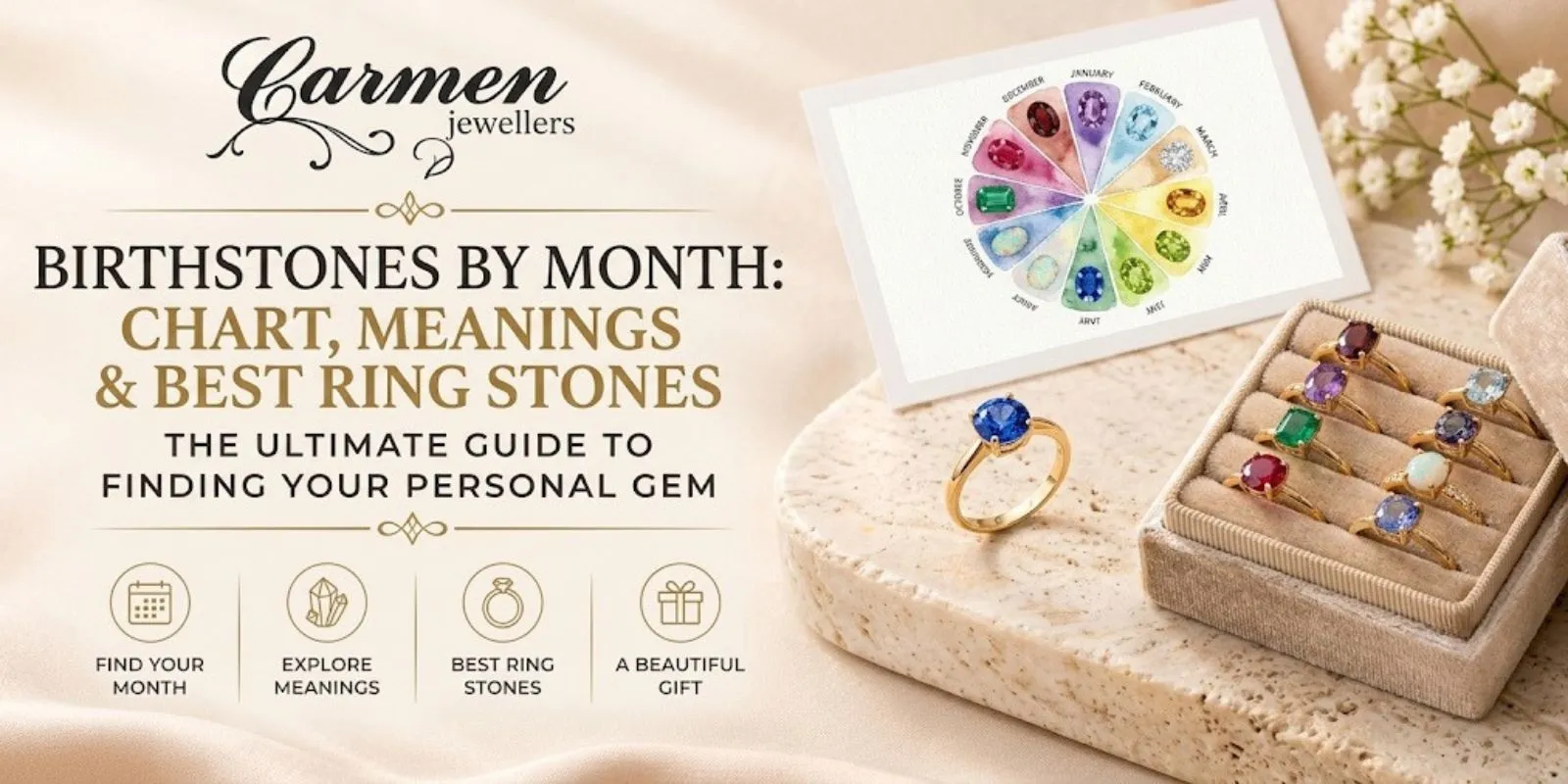
Each month has one or more birthstones: January garnet, February amethyst, March aquamarine, April diamond, May emerald, June pearl, July ruby, August peridot, September sapphire, October opal, November topaz and December turquoise, with extra options in several months. Stones differ a lot in hardness, so the best birthstone for a daily ring is not always the best for a pendant. The chart below lists every month, how durable each stone is and the jewellery style that suits it.
Birthstones by month: the full chart
The stones below follow the GIA birthstone list, which includes alternatives for months that have more than one. Hardness is shown on the Mohs scale, where 10 is the hardest. Mohs figures are approximate ranges from general gemmological references, and they vary by stone variety.
| Month | Birthstone(s) | Approx. Mohs Hardness | Best Suited To |
|---|---|---|---|
| January | Garnet | 6.5 to 7.5 | Rings with care, earrings, pendants |
| February | Amethyst | 7 | Rings, earrings, pendants |
| March | Aquamarine, bloodstone | 7.5 to 8 (aquamarine) | Rings, earrings, pendants |
| April | Diamond | 10 | Everyday rings |
| May | Emerald | 7.5 to 8 | Earrings and pendants, rings with protective settings |
| June | Pearl, moonstone, alexandrite | 2.5 to 4.5 (pearl) | Earrings and pendants, occasional rings |
| July | Ruby | 9 | Everyday rings |
| August | Peridot, spinel | 6.5 to 7 (peridot), 8 (spinel) | Earrings and pendants, spinel in rings |
| September | Sapphire | 9 | Everyday rings |
| October | Opal, tourmaline | 5.5 to 6.5 (opal), 7 to 7.5 (tourmaline) | Pendants and earrings for opal, rings for tourmaline |
| November | Topaz, citrine | 8 (topaz), 7 (citrine) | Rings, earrings, pendants |
| December | Turquoise, tanzanite, zircon | 5 to 6 (turquoise), 6.5 to 7 (tanzanite) | Pendants and earrings, careful ring wear |
The modern list is commonly traced to an early twentieth century standardisation by the American jewellery trade, with later additions such as tanzanite. Older traditional lists differ, which is why you may see sardonyx for August or bloodstone for March in older guides.
How durable is your birthstone?
Hardness measures scratch resistance, but toughness matters too. A stone can resist scratches and still chip or split along internal weaknesses. Use these tiers as a practical guide.
- Built for daily wear: diamond, ruby and sapphire. Their high hardness makes them the usual choices for rings worn every day.
- Good with sensible care: aquamarine, topaz, spinel, tourmaline, citrine and amethyst. These suit rings if you remove them for heavy work and avoid hard knocks.
- Choose a protective design: emerald and garnet. Emeralds often contain natural inclusions that make them more brittle than their hardness suggests, so a setting that shields the stone helps.
- Best for earrings and pendants: pearl, opal, turquoise, moonstone and peridot. These are softer or more easily damaged, and they sit away from the impacts a ring takes.
When a stone is softer than you would like, you do not have to give up the birthstone. Moving it from a ring to a pendant is often the simplest way to keep wearing it for years.
Ring, earrings or pendant: choosing the right piece
Start with how the piece will be worn, then match the stone.
A ring worn daily. Choose a stone from the first two tiers above. A bezel or low-profile setting protects the edges, and a plain band keeps the design simple.
Earrings. Earrings take far fewer knocks than rings, so softer stones such as pearl, peridot and opal work well here. Studs and drops suit different lifestyles, so think about how you wear them.
A pendant. A pendant sits away from the hands, which makes it the gentlest option for opal, turquoise and moonstone.
A gift for someone else. If you are unsure of a ring size, a pendant or earrings avoid the guesswork. Our ring size chart helps if you do choose a ring.
If you want the story of one particular stone first, we have separate guides to garnet, amethyst, aquamarine and emerald.
Meanings and traditions
Birthstone meanings come from folklore and tradition rather than science, so treat them as symbolism you can enjoy. Commonly attached meanings include protection and constancy for garnet, calm for amethyst, courage for aquamarine, enduring love for diamond, rebirth for emerald, purity for pearl, passion for ruby, and loyalty for sapphire. Different cultures assign different meanings, and none of them change how a stone looks or performs.
What matters more for most buyers is personal connection. Many people choose a birthstone for a partner, a child or a parent, or pick the stone of a month that carries a memory. Others mix months, for example a mother’s ring that holds each child’s stone. Our team can talk through settings that keep several stones balanced.
Natural, lab-grown and alternative stones
Some birthstones are available both as natural and as laboratory-grown stones, including diamond, ruby, sapphire and emerald. Lab-grown stones are chemically the same as their natural counterparts, and they usually cost less. Our guide to lab-grown diamond rings under $2000 says lab-grown diamonds are roughly 30 to 50% cheaper than natural, and that gap is a useful reference point, though it differs by stone and quality.
If a birthstone is out of budget, the month’s alternative can help. June offers moonstone or alexandrite beside pearl, and August offers spinel beside peridot. For April, you can browse our diamonds to compare options. Ask the team to confirm whether a stone is natural, lab-grown or treated before you buy.
Caring for your birthstone
Care depends on the stone family, so check which group yours belongs to.
- Hard stones (diamond, ruby, sapphire): warm water, a little mild soap and a soft brush are usually enough.
- Quartz family and similar (amethyst, citrine, topaz, aquamarine): mild soap and water work well, but keep amethyst out of strong, prolonged sunlight because its colour can fade.
- Emerald: avoid ultrasonic cleaners and steam, since inclusions and treatments can be affected. Wipe gently with a soft cloth.
- Pearl, opal and turquoise: wipe with a soft damp cloth and avoid chemicals, perfume and hairspray. Store pearls and opals separately so harder stones do not scratch them.
For any valuable piece, have the settings checked regularly, because loose prongs are the most common cause of lost stones. Our repairs service can inspect and tighten settings.
About Carmen Jewellers
Carmen Jewellers is an independently owned family jeweller in Perth, Western Australia. The business has operated for more than 35 years and is a member of the Showcase Group. You can find us at Lakeside Joondalup Shopping City (Shop GD T004, 420 Joondalup Dr, Joondalup) and Midland Gate Shopping Centre (Shop 101, 274 Great Eastern Hwy, Midland). Our team offers custom design, remodelling, repairs, gold trade-in and valuations, and can help you choose a birthstone piece that suits how you live.