

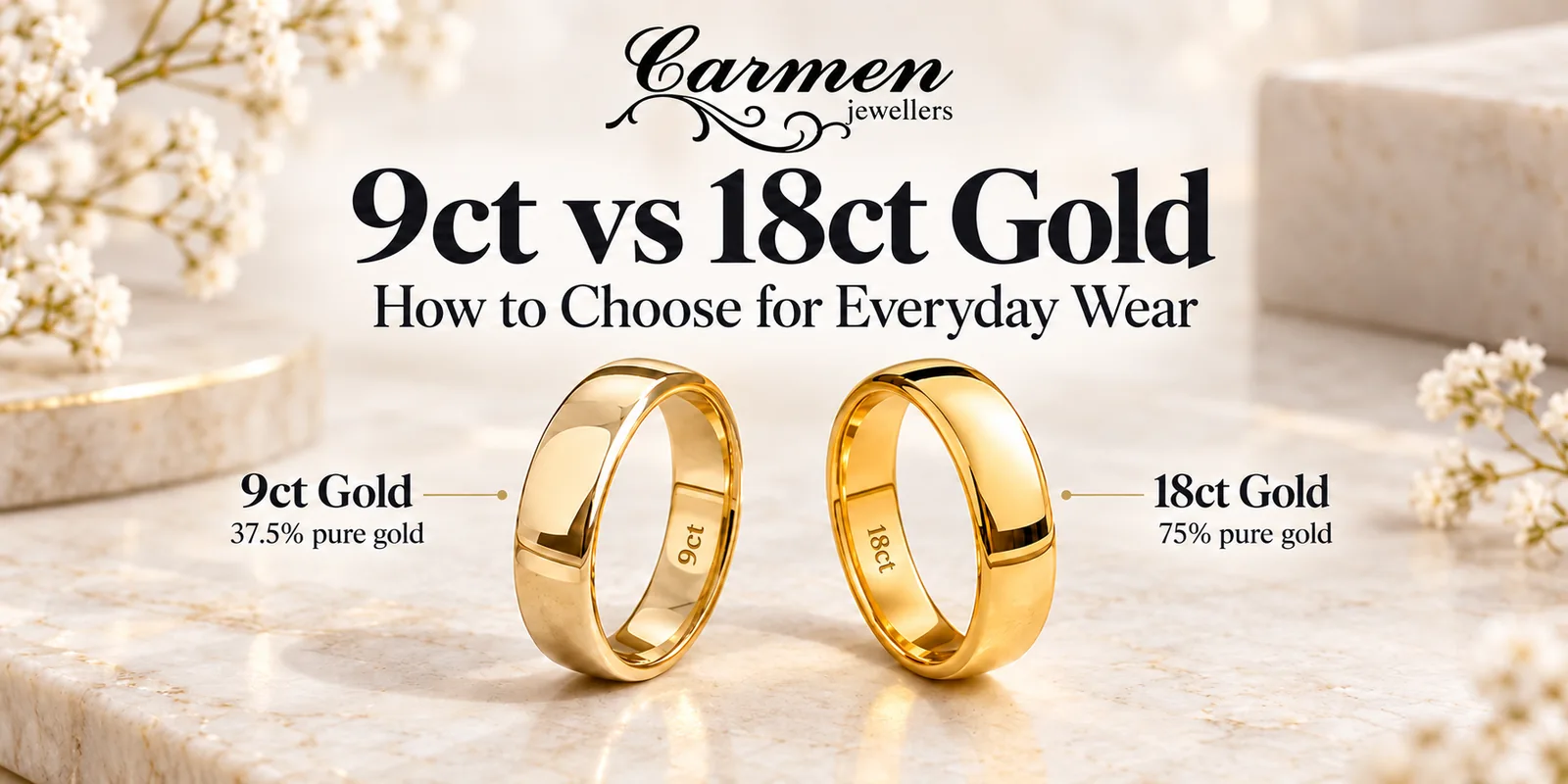
The main difference in 9ct vs 18ct gold is gold content: 9ct contains 37.5% gold while 18ct contains 75%. Both can suit everyday jewellery. Your decision should also consider the finished design, colour, construction and budget. Compare similar pieces and ask about their specific alloys rather than assuming that a higher carat number guarantees a better choice.
What does 9ct vs 18ct gold actually mean?
Gold purity is expressed in parts out of 24. Nine-carat gold contains nine parts gold while eighteen-carat gold contains eighteen.
The remaining metal forms part of the alloy. These additional metals help create the colour and working properties needed for jewellery.
You may see 9ct marked as 375 and 18ct marked as 750. The Birmingham Assay Office explanation of gold fineness confirms these purity equivalents. Its hallmarking procedures concern the UK, so do not assume every Australian item carries a complete UK hallmark.
A purity mark gives useful information. It does not tell you whether a clasp is secure, a band is well proportioned or a gemstone has been set properly.
Is 9ct gold real gold?
Yes. Nine-carat gold is a gold alloy. It should not be confused with a base-metal piece carrying a thin gold coating.
However, a product description needs context. Read the complete material description rather than relying on the word “gold” alone.
Does 18ct mean the whole piece is better?
It means the alloy contains a higher proportion of gold. Assess the workmanship and design separately.
A comfortable piece with suitable construction may be a better purchase for you than one selected only for its carat number.
9ct vs 18ct gold at a glance
| Factor | 9ct gold | 18ct gold |
|---|---|---|
| Gold proportion | 37.5% | 75% |
| Common fineness number | 375 | 750 |
| Other alloy metals | 62.5% | 25% |
| Purchase comparison | Assess the complete piece | Assess the complete piece |
| Colour | Depends on alloy and finish | Depends on alloy and finish |
| Everyday suitability | Design and use matter | Design and use matter |
The 9ct vs 18ct gold comparison is a starting point. It cannot predict the performance of two finished rings without knowing their dimensions, alloys and manufacturing details.
9ct vs 18ct gold: which suits everyday wear?
Ask what “everyday” means for the jewellery you are buying. A pendant worn beneath a shirt has a different routine from a ring that frequently contacts hard surfaces.
For a ring, discuss band width, thickness and setting height. Ask how the design should be worn during work, exercise and household tasks.
For earrings, check weight, balance and fastening comfort. For a chain, look at the links, clasp and suitability for the pendant it will carry.
Is 9ct always harder or more durable?
Do not treat that as a universal rule. Hardness and durability are not interchangeable descriptions and the carat number alone does not settle either question.
Ask the jeweller about the particular alloy and finished design. A thin section, worn clasp or exposed setting needs attention regardless of gold purity.
When comparing 9ct vs 18ct gold, avoid letting a broad claim about toughness replace an inspection of the actual piece.
What if you have sensitive skin?
Ask which metals are present in the alloy. Neither carat label is a complete ingredient list.
Explain any known sensitivities before ordering. Do not assume that moving from 9ct to 18ct automatically resolves a reaction.
Will the colour look different?
Compare actual pieces under similar lighting. Gold purity matters but it is not the only influence on colour.
Two yellow gold alloys can have different tones. Surface finish also changes how light reflects from the jewellery.
Use Carmen’s warm-toned pieces to explore designs before comparing their individual material descriptions.
White gold requires a separate finish discussion. Ask whether the piece is rhodium plated and how that finish should be maintained. Carmen’s existing ring guidance notes that white gold may need occasional replating.
Do not choose a carat solely from a photograph. If possible, compare pieces beside jewellery you already wear.
Why does 18ct gold often cost more?
Higher gold content contributes to the price, but the complete quotation includes more than the metal.
Weight, gemstones, construction, design work and finishing can all influence what you pay. A comparison between unrelated products cannot isolate the effect of changing carat.
For 9ct vs 18ct gold, request quotations for the same design wherever possible. Specify the same size, dimensions, gemstone details and finish.
A worked example without changing gold prices
Imagine two hypothetical items with exactly 4 grams of gold alloy each. Exclude gemstones and non-gold components from this illustration.
- The 9ct item contains 4 × 0.375 = 1.5 grams of pure gold.
- The 18ct item contains 4 × 0.75 = 3 grams of pure gold.
The second item contains twice as much pure gold by weight. That does not mean its retail price must be exactly double.
This is a composition example, not a valuation or a Carmen quotation. Equal-weight items also need not have identical dimensions.
A practical quotation checklist
Use this worksheet when comparing two proposed purchases. Ask the jeweller to fill any gaps instead of guessing from photographs.
| Check | Question to ask |
|---|---|
| Material | What carat and colour alloy are quoted? |
| Dimensions | Are width, thickness and size comparable? |
| Construction | Is the piece hollow or solid in construction? |
| Gemstones | Are stone type, quality and size the same? |
| Finish | Does the quote include plating or a special texture? |
| Future work | What alterations and maintenance may be possible? |
The word “solid” can cause confusion. A piece made from a gold alloy can still have hollow construction. Ask about material and construction separately.
Carmen’s guide to jewellery construction and craftsmanship provides useful context for considering how a piece is made.
How should you decide on 9ct vs 18ct gold?
Start with three priorities: the design you want, a comfortable budget and the way you will wear the piece.
Consider a hypothetical buyer choosing small everyday earrings. After checking the fastening and comfort, they may prefer a 9ct option that fits their budget.
Another buyer may prioritise higher gold content in a keepsake pendant and choose 18ct. Neither decision establishes a rule for everyone else.
For rings, ask to compare the finished feel on your hand. For gifts, consider the recipient’s existing jewellery and preferences rather than guessing that higher purity is always their first priority.
Keep any quotation in Australian dollars and confirm what it includes. Ask when the quotation expires because material prices and manufacturing costs can change.
Frequently Asked Questions
Is 18ct gold twice as pure as 9ct gold?
Yes. Its gold proportion is 75% compared with 37.5%. That relationship does not mean a finished piece must cost twice as much.
Can you wear 9ct gold every day?
It can suit regular wear when the design and construction are appropriate. Follow the care guidance for the complete piece and remove it for unsuitable activities.
Is 18ct gold too soft for a ring?
Not automatically. Assess the specific alloy, band dimensions and setting. The carat number alone does not determine whether a ring suits your routine.
Can I wear 9ct and 18ct rings together?
Ask a jeweller to assess the pair. Contact between settings, differences in shape and the way the rings sit together matter alongside their materials.
Which should I choose for a gift?
Compare the recipient’s preferred colour, style and comfort with your budget. Ask about the complete piece rather than selecting on purity alone.
Choose the piece as well as the purity
A useful 9ct vs 18ct gold comparison ends with a suitable design, clear specifications and a quotation you understand.
Explore Carmen’s lighter-toned designs and ask the team to explain the material options available for a piece you like.