

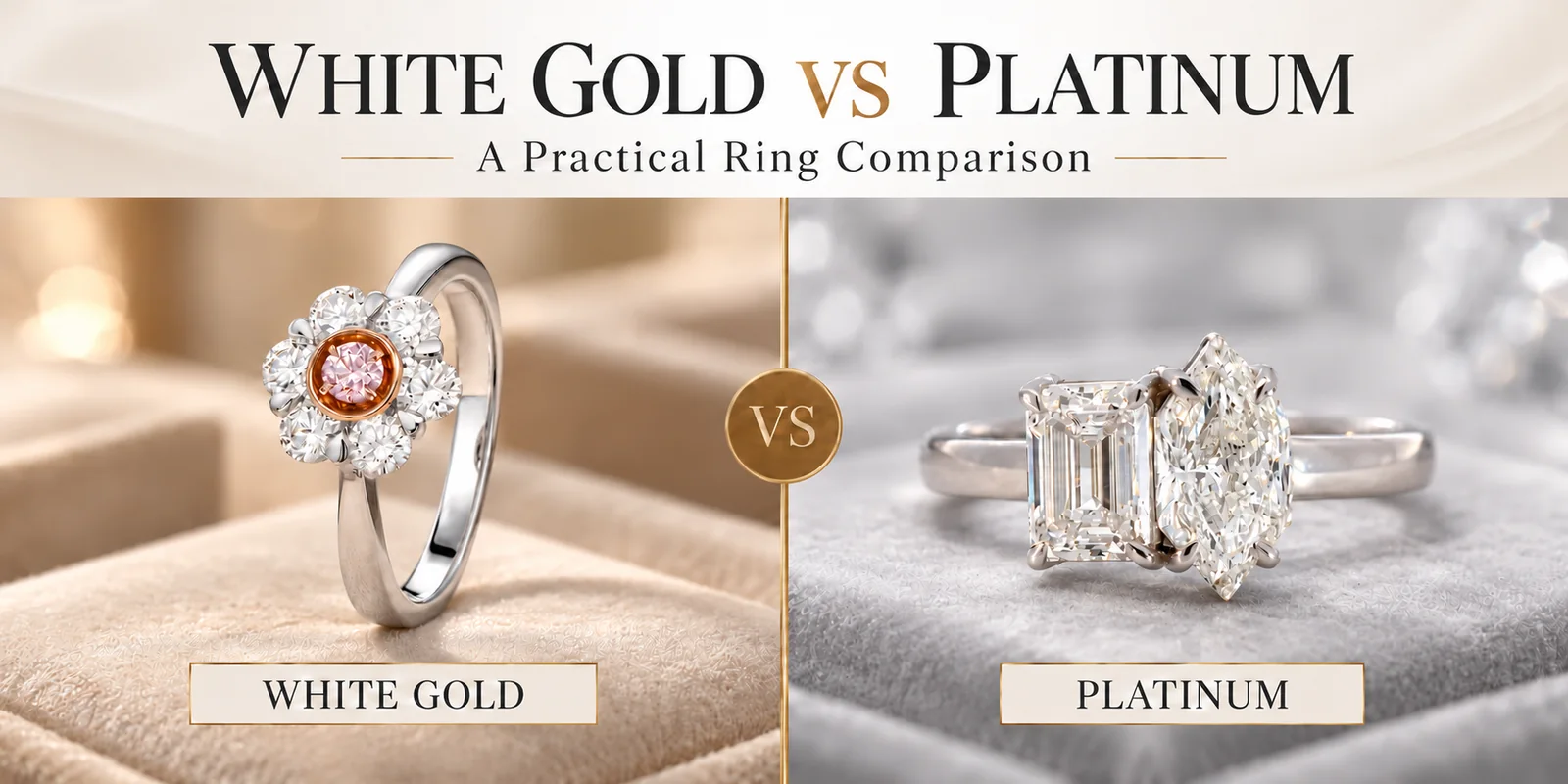
What is the difference between white gold and platinum?
White gold is an alloy made by combining gold with other metals. Platinum jewellery uses a different precious metal and its own alloys.
White gold is often rhodium plated to create a bright white surface. Platinum’s white colour comes from the metal itself.
The GIA guide to white metals for rings explains the distinction between these materials and the role of rhodium plating.
When comparing white gold vs platinum, identify the actual specifications. “White metal” is not enough information for a purchase.
What should the product description tell you?
For white gold, check the gold carat and whether the piece is plated. For platinum, check the stated fineness.
Ask about any parts made from a different metal. A ring can have a setting and band with different specifications.
Keep this information with the quotation. It gives you a reference when discussing future maintenance or alterations.
White gold vs platinum at a glance
| Question | White gold | Platinum |
|---|---|---|
| What creates the white appearance? | Alloy colour and often rhodium plating | The naturally white metal |
| How does it feel? | Usually lighter in a comparable design | Usually heavier in a comparable design |
| How can its appearance change? | Plating may wear and reveal a warmer tone | Surface wear may develop a patina |
| Does it resist all scratches? | No | No |
| What maintenance should you discuss? | Inspection, finish and possible replating | Inspection and preferred surface finish |
| Is the price fixed by metal alone? | No | No |
Use these differences to guide questions rather than to select a winner immediately. The finished design still matters.
White gold vs platinum: which looks better on your hand?
View both options under similar lighting. Compare the finish, band shape and how the ring sits against your skin.
A brightly polished platinum ring and a freshly plated white gold ring may look similar at first. Ask to see examples of how each finish changes with wear if the jeweller has suitable pieces available.
Do not assume you must preserve a mirror finish indefinitely. Some buyers prefer a softer appearance while others want a bright surface and accept the maintenance involved.
Will the metal change how a diamond looks?
The setting forms part of what you see around the stone. Consider the diamond and ring together rather than choosing each from separate photographs.
Carmen’s explanation of diamond colour grades provides context for this discussion. Ask to compare stones and settings in similar conditions before deciding.
Choose the appearance you prefer.
Which metal suits daily wear?
Start with the design and your routine. A low-profile ring may feel different from a tall setting regardless of the metal.
Ask whether the band dimensions and setting suit the way you use your hands. Discuss when the ring should be removed for work, exercise or household tasks.
Platinum is not immune to marks. White gold is not automatically unsuitable for everyday wear. Neither material removes the need to inspect claws, settings and other vulnerable parts.
White gold vs platinum: does heavier mean better?
No. Weight is a preference as well as a practical consideration.
Try a comparable width and profile in each metal. Move your fingers and notice whether the ring feels comfortable beside neighbouring fingers.
Weight preferences differ. An online weight figure cannot replace trying a suitable sample.
What maintenance should you expect?
Carmen’s existing custom-ring guidance describes platinum as naturally white with a patina that can develop over time. It also notes that white gold may require occasional rhodium replating.
Those are useful starting points, but avoid treating maintenance as a fixed calendar.
For white gold, ask what the finish looks like as it wears and how the team decides when replating is appropriate. For platinum, discuss whether you prefer to retain patina or periodically refresh the surface.
In both cases, distinguish cosmetic work from structural inspection. A shiny ring can still need attention to a worn setting.
[TEAM INPUT: Add a verified explanation from Carmen’s jeweller of how finish maintenance is assessed. Do not promise a fixed replating interval or free servicing.]
How should you compare white gold vs platinum costs?
Request current quotations for matching designs. Keep the ring size, band dimensions and gemstone specifications consistent wherever possible.
Do not assume platinum will always cost more or that white gold will always be the lower-cost option. Compare the finished quotations.
Ask whether the price includes the agreed finish and which future services are charged separately. Confirm the quotation validity period before ordering.
A useful ownership budget has three parts: the purchase price, any expected finish maintenance and a separate allowance for unplanned repairs. Future costs are uncertain, so treat this as a planning framework rather than a guaranteed total.
A buyer scorecard for white gold vs platinum
Use the following original worksheet to organise your preferences. It is a decision aid, not a scientific rating of either metal.
Give each priority an importance score from 1 to 3. After trying comparable rings, give each option a suitability score from 1 to 5.
| Priority | What to assess before scoring |
|---|---|
| Comfort | Weight, profile and feel on your hand |
| Appearance | Your preferred new and worn finish |
| Maintenance | Your willingness to arrange finish work |
| Budget | The actual quotation for the same design |
| Ring pairing | How it sits beside your existing band |
Multiply importance by suitability for each row and add the results separately.
For example, a priority scored 3 for importance and 4 for suitability contributes 12 points. These numbers express your preferences, not a jeweller’s assessment of durability.
If one ring feels uncomfortable, do not let a high total persuade you to buy it. Use the exercise to identify questions that remain unanswered.
Can you pair either metal with an existing ring?
Bring your existing ring to the appointment. Ask the jeweller to check how the bands and settings contact each other.
Metal choice is only one consideration. Ring height, shape, stone placement and movement can affect how a pair wears.
Explore Carmen’s bands to compare alongside your current ring before narrowing your choices. Check the fit in person where possible.
Do not assume that a photograph showing two rings together proves they are suitable for continuous paired wear.
Frequently Asked Questions
Is there a winner in white gold vs platinum?
Neither is universally better. Compare comfort, appearance, design and maintenance with your budget. The best choice depends on the actual ring and your priorities.
Does white gold turn yellow?
A warmer underlying colour can become visible as rhodium plating wears. Ask whether the ring is plated and how its finish should be maintained.
Does platinum scratch?
Yes. Platinum can show surface wear and develop a patina. It should not be described as scratch-proof or maintenance-free.
Which is better if I have a known metal sensitivity?
Ask for the exact alloy composition and explain the sensitivity before ordering. Neither a colour description nor a product photograph provides that information.
Can either ring be resized later?
Possibly, but the design, setting and required adjustment matter. Ask about the specific ring before purchase rather than assuming every style can be altered.
Compare the rings before choosing the metal
A white gold vs platinum decision becomes easier when you have tried comparable designs and discussed their care.
Browse Carmen’s bright-finish ring and jewellery designs and ask the team about the specifications of a piece you like. If you are considering platinum, confirm the options available rather than assuming every design can be supplied in both metals.