

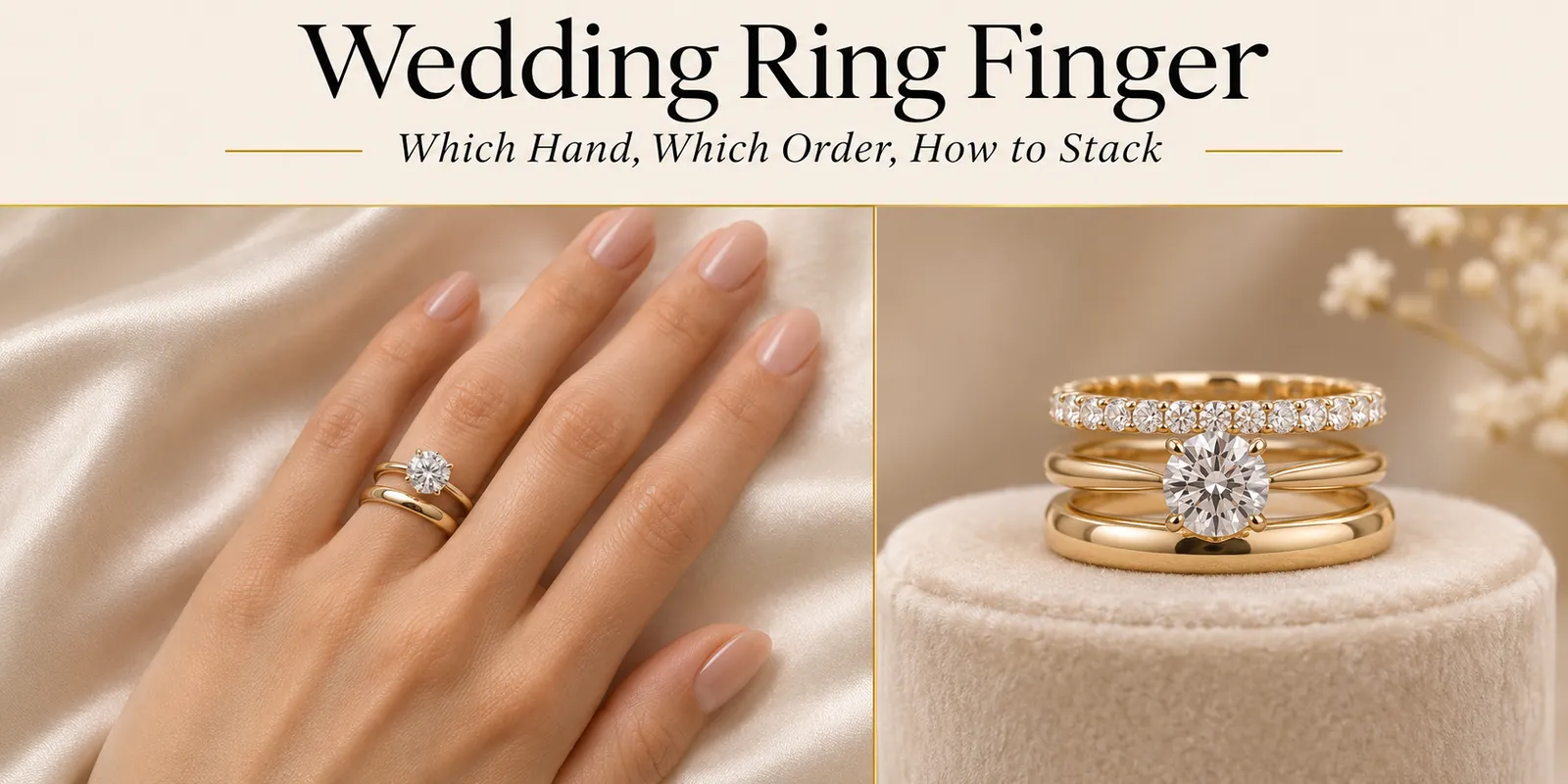
In Australia, a wedding ring is worn on the fourth finger of the left hand, known as the ring finger. The engagement ring usually sits on the same finger, with the wedding band closest to your hand. Plenty of people choose differently for cultural, practical or personal reasons, and no law says otherwise. This guide covers the order, the exceptions, how to stack rings so they fit well, and the sizing details that catch people out.
Why the left ring finger?
The left ring finger became the Western default largely because of an old Roman belief. Easy Weddings notes that the Romans allegedly thought a vein ran from this finger straight to the heart, which they called the “vena amoris” or vein of love. Modern anatomy does not support this idea, since every finger has veins connecting to the heart, so treat it as a charming myth rather than a medical fact.
The habit stuck anyway. The same source describes left-hand wearing as traditional in Australia, the UK, the USA, New Zealand and most of Asia. A practical reason is often added: for right-handed people the left hand tends to take fewer knocks, which suits a ring worn every day.
The order of wearing your rings
The wedding band goes on first and sits closest to your hand, and the engagement ring goes on above it. This keeps the plain band nearest the palm and lets the engagement ring show.
- Before the ceremony: brides often move the engagement ring to the right hand so the left ring finger is free for the band. Easy Weddings describes this practice for Australian weddings.
- After the ceremony: the engagement ring returns to the left hand, worn above the wedding band.
- Eternity ring: there is no fixed rule. Some people wear it on the other side of the engagement ring to form a three-ring stack. Others wear it on the other hand. Try your combination before you commit, because an eternity band can change how the other rings sit.
- Metals: a harder band worn against a softer ring can wear the softer one faster. Our guide to pairing an engagement ring with a wedding band covers matching and mixing metals, and our wedding band guide notes that platinum beside softer gold may wear the gold ring faster over time.
Variations by culture, handedness and circumstance
There is no single correct answer, because families bring many traditions. Easy Weddings lists these common variations:
- Russia, Poland and Greece: the wedding ring is commonly worn on the right hand.
- India: right-hand wearing was customary because the left hand was once considered impure. Either hand is widely accepted now.
- Sri Lanka: grooms typically wear the ring on the right hand and brides on the left.
- Left-handed wearers: some choose the right ring finger so the ring interferes less with daily tasks.
- Widowed spouses: some move the ring to the right hand.
- Men with an engagement ring: some wear it on the right hand and keep the left ring finger free for the wedding band.
Choose the hand and finger that fit your family’s customs and your daily routine. A ring worn differently from someone else’s rule is still your ring.
Stacking rings and choosing band widths
Stacks look best when the rings are designed to sit together. Band width should suit the proportions of your rings, though the widths do not need to match. Use this table as a starting point, then try the rings on together.
| Combination | What to consider |
|---|---|
| Solitaire with a plain band | A straight or pavé band can sit flush against a simple setting. |
| Halo with a band | A band that follows the halo outline, or curves around it, can close the gap. |
| Low-set or detailed ring | A curved band may suit better than a straight one. |
| Wedding band with an eternity ring | Choose similar widths so neither ring dominates, and check how the metals wear together. |
| Three rings together | Check comfort when you make a fist, because a stack feels snugger than a single ring. |
These are starting points rather than rules. Our pairing guide walks through shapes and settings in more detail.
Sizing: every finger and every day is different
Your ring finger may be a different size from your other fingers, and your left and right hands are rarely identical. If you move a ring to another finger or hand, check the fit before relying on it.
Fit also shifts through the day. Our ring resizing guide lists heat, salty food, time of day, pregnancy, weight change and arthritis among the causes of a snug ring. For a more reliable result:
- Measure when your hands are warm and relaxed, such as the end of the day.
- Use the Carmen ring size chart as a guide, then confirm the size in store.
- Remember that most rings can be resized by about two sizes, depending on design and thickness. Full eternity bands, tension-set rings and some other styles are generally hard or impossible to resize.
- If a ring causes pain, tingling, numbness or discolouration, remove it promptly.
The same guide estimates a simple resize at about $75 to $200 AUD, with a detailed quote provided before any work begins.
Common mistakes to avoid
- Buying the wedding band without trying it against the engagement ring.
- Choosing a full eternity band as your only band without knowing it generally cannot be resized.
- Sizing in the cold, or straight after exercise, when fingers are at their smallest or largest.
- Assuming one rule applies to everyone, including partners from different backgrounds.
- Mixing metals of very different hardness without thinking about long-term wear.
- Leaving a ring that has become tight, which can affect circulation and comfort.
About Carmen Jewellers
Carmen Jewellers is an independently owned family jeweller in Perth, Western Australia. The business has operated for more than 35 years and is a member of the Showcase Group. You can find us at Lakeside Joondalup Shopping City (Shop GD T004, 420 Joondalup Dr, Joondalup) and Midland Gate Shopping Centre (Shop 101, 274 Great Eastern Hwy, Midland). Browse our wedding rings or book an appointment to try rings together with our team.